The need for energy security, missile attacks, and reconfiguration of relations drive New Delhi and Abu Dhabi to forge a strategic security partnership
In response to the growing instability in the West Asia region, characterized by missile attacks, alliance shifts, and energy route competition, India and UAE are working on establishing a strategic defense partnership to ensure their respective needs for energy security and economic stability. The formation of the partnership is based on the two countries’ common interests against an increasingly unstable geopolitical environment.
Missile Attacks on UAE Trigger Strong Indian Response
Prime Minister Narendra Modi strongly condemned the attacks made on the port of Fujairah, located in the United Arab Emirates.
Strongly condemn the attacks on the UAE that resulted in injuries to three Indian nationals. Targeting civilians and infrastructure is unacceptable.
— Narendra Modi (@narendramodi) May 5, 2026
India stands in firm solidarity with the UAE and reiterates its support for the peaceful resolution of all issues through…
Stating, “Strongly condemn the attacks on the UAE that resulted in injuries to three Indian nationals. Targeting civilians and infrastructure is unacceptable. ”
According to reports, there have been continuous threats of air strikes on the United Arab Emirates ever since the Iran-US confrontation became serious because of the presence of US military installations in the UAE and their association with Israel.
Scale of Attacks on UAE Territory
| Type of Threat | Number Intercepted |
| Ballistic Missiles | 549 |
| Cruise Missiles | 29 |
| Drone Attacks | 2,260 |
Unlike many Gulf ports, Fujairah and Khor Fakkan are situated outside the Strait of Hormuz, along the Gulf of Oman, which makes them very important for maintaining the flow of global energy if the strait is blocked.
Marking Fujairah a significant strategic target.
India-UAE Defence Partnership
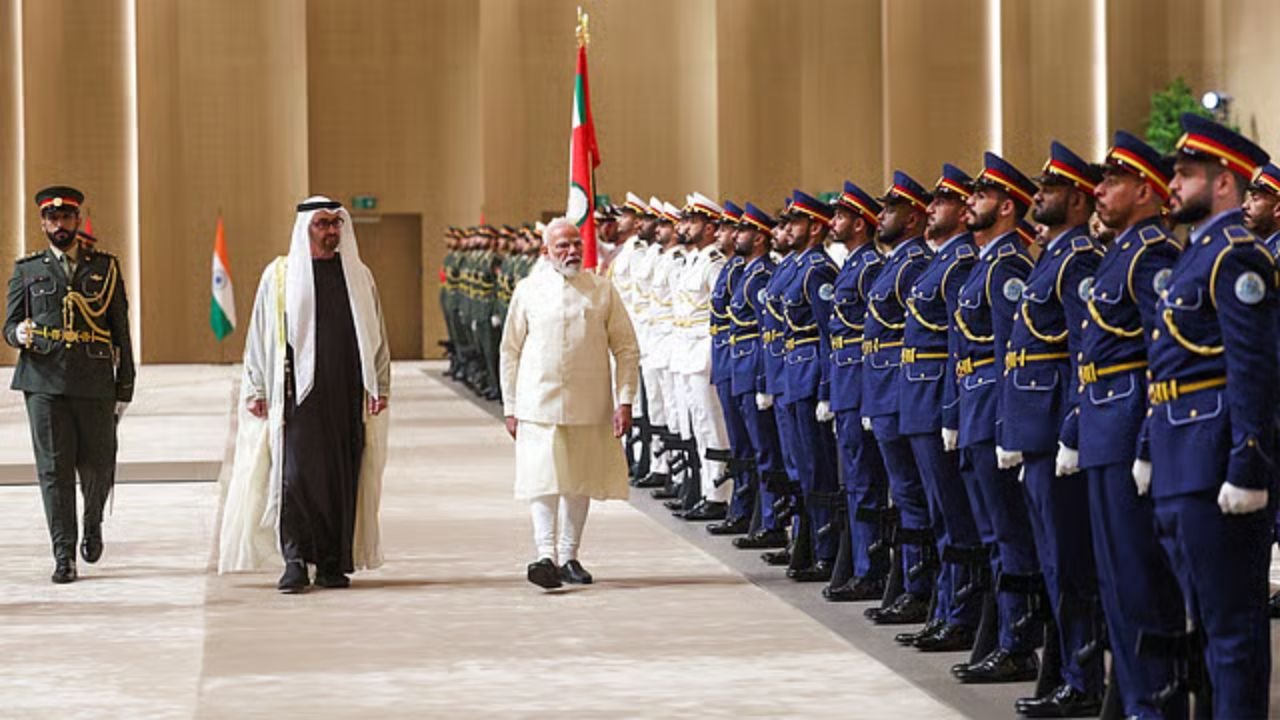
In January, during a high-level official’s visit to New Delhi, UAE President Sheikh Mohammed bin Zayed Al Nahyan and PM Modi signed the Letter of Intent (LoI) to form a Strategic Defence Partnership Agreement.
The draft agreement, which is expected to be finalized in six months, will include the following areas:
- Defence industrial collaboration
- Advanced defence innovation
- Cybersecurity cooperation
- Special operations coordination
- Counter-terrorism measures
In this context, it can be noted that while other nations like Saudi Arabia and Qatar have chosen a policy of forging strong ties between their militaries and Pakistan, the UAE has chosen a completely different approach.
One of the major steps taken by the UAE in this context is the refusal to rollover $3.45 billion of debt that Pakistan owes to it.
Energy, Trade Corridors, and Economic Stakes Drive Partnership
Economic interdependence remains a cornerstone of India-UAE relations, particularly in the energy sector.
Also Read: BJP marks a Historic Win in West Bengal Assembly Elections 2026; Ending Mamata’s 15-year reign
India’s Energy Imports from UAE (2024–25)
| Category | Value (USD) | Share |
| Crude Oil | $13.6 Bn | 10% of total imports |
| LNG & LPG | $7.51 Bn | — |
| Total Volume | 23 million tons | — |
Apart from energy, both countries have begun investing in infrastructure and trade connectivity. An economic corridor connecting Mundra (India), Fujairah (UAE), and Aqaba (Jordan) is being considered as an important economic artery.
UAE is set to develop a 360-km railway in Jordan for which it invested $2.3 billion, connecting the phosphate and potash mining area in the region to Aqaba Port.
Strategic Alignment Amid Global Uncertainty
India’s move to sign a defense pact with the UAE signals a calculated geopolitical shift amid the growing tensions between the US and Iran over dominance in the Strait of Hormuz.
The partnership just does not reflect defence, but represents a broader spectrum of:
- Securing energy supply chains
- Ensuring maritime stability
- Fighting against terrorism and radicalisation
- Empower economic strength
On May 18, PM Modi is set to land in Abu Dhabi as part of his journey to the Netherlands, to enhance India-UAE relations, especially in light of the new trade corridor linking Mundra-Fujairah-Aqaba.
The partnership between India and UAE will serve as a crucial pillar for stability in an ever-polarizing region, backed by their common interests and pragmatic collaboration.
Also Read: 8 Infected Hantavirus Outbreak On Cruise; WHO Raises Global Alarm, Launching Global Contact Tracing