The opposition accuses the Centre of delaying women’s quota implementation by linking it to delimitation, turning a landmark reform into a fresh political flashpoint ahead of 2029.
What Sparked the Clash?
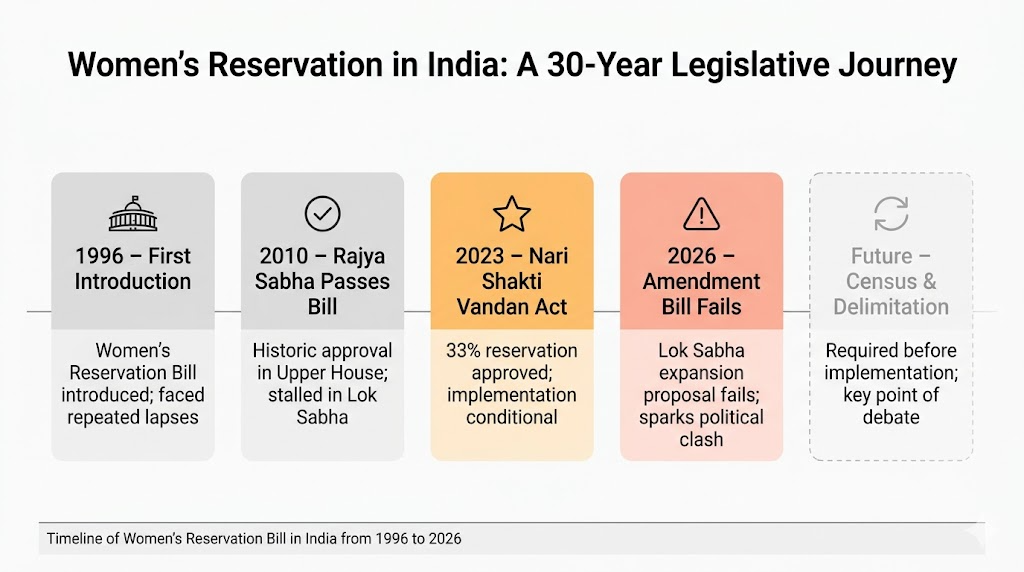
The debate on the issue of women’s reservation in the Lok Sabha has reemerged, owing to the defeat of an imperative bill in the lower house of parliament. The bill sought to increase the size of the House to allow reservation of seats for women at 33%.
Congress Party seeked this opportunity to challenge the government’s sincerity towards its implementation, stating that there is no need for unnecessary delay in implementing the women’s quota legislation.
It wants to conduct an all-party discussion and has presented itself as a party committed to achieving a consensus, while at the same time criticising the establishment for politicizing the move which was always perceived as an important for transforming gender politics in India.
It is not merely a case of legislative debate but rather a reflection of the long overdue reform which has been raised in Parliament several times but never implemented.
Also Read: Ex-AAP Raghav Chadha’s Relation with Its AAP MP’s: Key Link Explained
Delimitation Vs. Immediate Implementation
The core of the controversy centers on whether women’s reservation needs to be implemented at once or only post delimitation?
While the government maintains that implementation of the 33% quota requires the completion of the next round of Census and delimitation to allocate constituencies and create new seats, the opposition believes that the move could be executed at once and that too without altering any of the present 543 seats in the Lok Sabha.
According to critics, making the move dependent on delimitation could mean delayed implementation and more political consequences than intended.
Political Stake, Representation Gaps and Path Ahead
However, the gender gap in politics remains huge as the percentage of female members in Lok Sabha stands at around 14%, which is much lower compared to the 33% recommended in several forums. This gender gap makes the issue of the Women’s Reservation Bill very important, and explains its politicization.
| Category | Current Status | Proposed Target |
| Women MPs (Lok Sabha) | 14% (around 75–80 MPs) | 33% |
| Men MPs | 86% | — |
| Global Ranking (Women Representation) | 140s range | — |
| Reservation Goal | — | 1 in 3 seats |
For the Congress and other opposition political parties, the need to implement it immediately is an attempt to use the issue both as an immediate policy demand and as part of their strategy for the next general election slated for 2029. For the government, however, the connection with delimitation is crucial for balanced structure.