This past week, as votes were counted from Kerala, Assam, and Puducherry, there has been much interest in the political landscape of those regions and how they will impact future political battles for both national and regional parties throughout India. In addition to a very large voter turnout in each state, Prime Minister Modi has utilised this event to push for the Women’s Reservation Bill (debated for many years) by encouraging all legislators (regardless of party affiliation) to support laws that will increase women’s participation in politics at all levels.
These two events represent an important period in Indian politics, as different political parties are trying to assert their control and influence and as the debate continues to intensify for good governance reforms throughout the country.
Voting Concludes With Strong Turnout Across Three Regions
On Thursday night the polling was officially closed in Kerala, the southern state; Assam, the northeastern state; and Puducherry, the union territory. According to the local reports, and based on information from the election authorities, the voter turnout remained strong throughout this election day. At the point in time of mid-afternoon: Assam – 76% voter turnout, Kerala – 62.7% voter turnout, and Puducherry – 72% turnout. In Kerala the election officials indicated that the final result could end a lot higher than what it is now since the final percentage would include all voting ballots that were received. Rathan U. Kellar is the Chief Electoral Officer for Kerala.
He stated that there has never been this high of a turnout at past elections in Kerala based upon their current trends. Continuing in that vein, Kellar stated that “If we continue on this current trend, based upon what we are seeing so far, we are confident that we’ll see a turnout approaching or exceeding the 90% mark when polling ends.” If he is accurate, this will put Kerala as one of the highest percentages of voter participation for the region over the last few elections there. The official results for these three (3) regions are expected to be released on May 4th when the vote counting has completed.
The official results for the three regions are scheduled to be announced on May 4, following the completion of vote counting.
A Political Test for Modi’s BJP
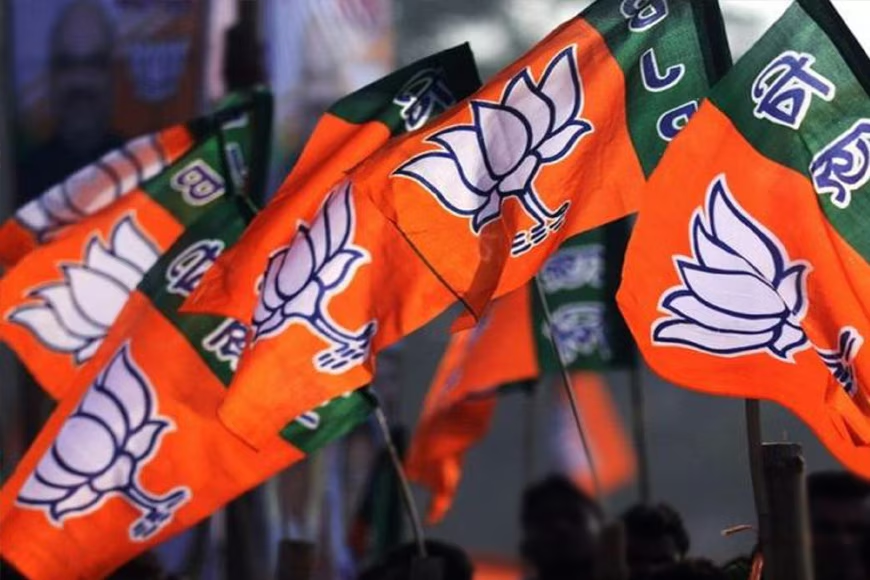
As an indication of the political temperature for the ruling Bharatiya Janata Party (BJP) and Prime Minister Narendra Modi, the regional election results are often used as an indicator to gauge the popularity of the BJP as we approach the next national election, even though the regional elections primarily address local issues. Analysts believe the results of the regional elections may provide some insight into how much support there may be for the BJP before the next national election.
In Kerala, the left and Congress-led coalition groups have historically been dominant, which makes it unlikely that the BJP has enough support to overcome the left and Congress coalition in that state.
Assam has become a key stronghold for the BJP within the northeast of India and represents a place where the BJP has seen tremendous electoral success during the past decade.
The political environment in Puducherry, on the other hand, is more fluid, and we will be able to see some shifting alliances with regard to regional parties and national parties.
Modi Pushes Women’s Reservation Bill
As the elections unfold, Prime Minister Modi has also renewed his request for political support of a major initiative to increase the number of women involved in parliamentary processes and how they are represented in parliament through other agencies (local government).
Modi expressed his desire for political support from all political parties through a blog post published Thursday, April 15. His blog called on party leaders and members to support the draft bill for implementing 33% reservations for women in the National Parliament and State Legislative Assemblies in India.
The initiative being developed is intended to speed up the implementation of the statutory requirements contained in the legislation passed in 2023 which provides for increased representation of women in legislative assemblies throughout India.
Modi wrote, “Women comprise close to half of India’s population but continue to be under-represented in the legislative process. If women are involved in the governance process and create policies for their communities, their experience and knowledge will enhance public policy and improve the quality of government.” The government will introduce a legislative process for discussion and approval during an extraordinary parliamentary session on the 16th of April.
Opposition Raises Political Concerns
Most opposing political parties have supported the proposed reservations for women; however, some leaders believe the government developed this idea as part of a plan, therefore, with a certain degree of premeditation relative to timing.
There are members of the opposition that have made it clear to the press that the effort to pass this legislation during peak election season could have been done to gain an advantage politically.
In general, the new proposed legislation continues to receive bipartisan agreement and demonstrates that there is currently at least one area in India’s politically divided history that has been able to come together and agree on.
If passed and implemented as written, this proposed measure will have a tremendous impact on changing India’s legislative environment, as it would generate one-third of all Indian legislative assembly and/or parliament seats being held by women legislators.
A Broader Regional Context
Most opposing political parties have supported the proposed reservations for women; however, some leaders believe the government developed this idea as part of a plan, therefore, with a certain degree of premeditation relative to timing.
There are members of the opposition that have made it clear to the press that the effort to pass this legislation during peak election season could have been done to gain an advantage politically.
In general, the new proposed legislation continues to receive bipartisan agreement and demonstrates that there is currently at least one area in India’s politically divided history that has been able to come together and agree on.
If passed and implemented as written, this proposed measure will have a tremendous impact on changing India’s legislative environment, as it would generate one-third of all Indian legislative assembly and/or parliament seats being held by women legislators.
Also Read Raj Bhavan Shake-Up Signals Strategic Shift Ahead of Elections