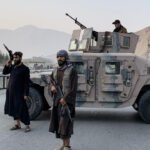
The relationship between Pakistan and Afghanistan is growing increasingly tense – escalating into what Islamabad describes as an “open war”. At the same time, U.S. President Donald Trump has reiterated that he will not be getting involved.
When asked by reporters about the military build-up in the region, President Trump answered with a positive statement regarding Pakistan’s military and government – expressing he believes that if he did get involved, both Pakistan’s prime minister and Pakistan’s military leader would be able to handle this issue on their own.
This indicates Donald Trump’s unwillingness to become involved in this developing situation, despite the fact that this is one of the area’s more serious military build-ups in several years.
Pakistan Declares “Open War”
The situation between Pakistan and Afghanistan has escalated dramatically after Pakistani Defence Minister Khawaja Asif announced an unrestricted state of ”war” against Afghanistan, and Pakistan claims that they have conducted at least 29 airstrikes across the country.
A Pakistani representative claims that approximately 297 Taliban would-be combatant casualties were inflicted as a result of the airstrikes, whereas the Taliban claims that 55 members of the Pakistani military were killed during the subsequent military response to Pakistan’s airstrikes, and at least 12 were captured.
These airstrikes are regarded as the largest Pakistani military interventions against Afghanistan since the Taliban returned to power last August (multinational coalition forces from the USA withdrew from the country). On the other hand, the Taliban is still the ruling party in Afghanistan because they regained control of Afghanistan after the withdrawal of American military personnel from the region. However, the increasingly hostile environment resulting from recent military conflict along the Pak-Afg border due to increased militant activity after the USA initiated the withdrawal of its military personnel from Afghanistan has created severe strain on the Pakistan-Taliban relationship.
Also Read: No one will be beyond reach’: Pakistan’s big message after declaring ‘open war’ against Afghanistan
Trump’s Diplomatic Shift
The shift in U.S. relations with Pakistan is apparent through the way that Trump has been responding to events in Pakistan since taking office a second time.
While U.S. relations with Pakistan were often contentious during the previous Biden administration, prior to the change of leadership in Washington, Trump had expressed some support for the current Pakistani leadership under Prime Minister Shehbaz Sharif and military chief Asim Munir, describing them as “great leaders” on various occasions.
Some analysts view his commendation toward the current leadership in Pakistan as constituting a diplomatic realignment toward Pakistan, particularly at this time in history when there are a number of significant geopolitical developments involving Pakistan.
The U.S. State Department did not intervene in the ongoing issues facing Pakistan; however, it did reiterate that the United States supports Pakistan’s “right to defend itself” against the Taliban’s attacks. In the same statement, U.S. officials criticised the Taliban for their failure to provide counter-terrorism assurances and for their permissiveness toward terrorist activity on Afghan soil.
Global Reactions: Ceasefire Calls Grow
The rise in violence has caused concern to the world community.
The UK government has requested both countries cease any further actions against each other immediately.
China is encouraging both parties to reach an agreement regarding a government-controlled ceasefire and halt hostilities between them.
Iran, as previously stated, is offering to be the mediator for discussions between its neighbours.
Furthermore, the U.S. Embassy located within Pakistan has sent out travel alerts to Americans indicating that military bases and commercial areas may be targeted by terrorism or terrorist individuals.
This has caused additional fears of long-term instability in an area that is already susceptible to cross-border militancy and political issues.
Why This Conflict Matters
A lengthy impassable frontier exists between Afghanistan and Pakistan, where many conflicts have occurred for years due to militant groups attempting to infiltrate the other country. Pakistan believes militants from Afghanistan’s side are creating problems in Pakistan, but the Taliban (or “the Taliban”) claims no fault and has even retaliated against Afghanistan for past assaults that originated from Afghanistan.
The recent escalation has created an extremely hazardous and critical moment; airstrikes against major cities in Afghanistan haven’t been carried out like this in many years. Should these retaliations continue between Afghanistan and Pakistan, the areas will become an expansive area of conflict beyond just skirmishes along the border and could ultimately result in major regional catastrophes.
The absence of any type of direct military involvement by President Trump could indicate a substantially new United States foreign policy approach that is based on limiting actual military intervention abroad and utilising diplomatic mechanisms/strategies to back partners. Numerous critics have indicated that remaining passive on the conflict between Afghanistan and Pakistan will result in increased tensions that will ultimately exceed the acceptable limit of tolerance of many Afghan-Pakistani individuals.
What Happens Next?
A lengthy impassable frontier exists between Afghanistan and Pakistan, where many conflicts have occurred for years due to militant groups attempting to infiltrate the other country. Pakistan believes militants from Afghanistan’s side are creating problems in Pakistan, but the Taliban (or “the Taliban”) claims no fault and has even retaliated against Afghanistan for past assaults that originated from Afghanistan.
The recent escalation has created an extremely hazardous and critical moment; airstrikes against major cities in Afghanistan haven’t been carried out like this in many years. Should these retaliations continue between Afghanistan and Pakistan, the areas will become an expansive area of conflict beyond just skirmishes along the border and could ultimately result in major regional catastrophes.
The absence of any type of direct military involvement by President Trump could indicate a substantially new United States foreign policy approach that is based on limiting actual military intervention abroad and utilising diplomatic mechanisms/strategies to back partners. Numerous critics have indicated that remaining passive on the conflict between Afghanistan and Pakistan will result in increased tensions that will ultimately exceed the acceptable limit of tolerance of many Afghan-Pakistani individuals.
Also Read: India Post 251 as Harmanpreet and Rawal Shine, but Batting Stumbles in Second ODI