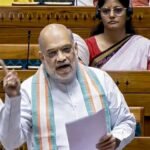
The ongoing battle in India against Naxalism was back in the news when Union Home Minister Amit Shah made a strong statement in Parliament.
When speaking before the Lok Sabha during the budget session, Shah argued that Naxalism is not caused by a lack of development but rather is the effect of left-wing ideology. He also blamed political policies enacted during the reign of ex-prime minister Indira Gandhi for the growth of the Naxalist movement.
His comments led to renewed discussion on the source of one of the most enduring internal security threats in India.
Ideology, Not Development
Union Minister Amit Shah has said that Naxalism in India has not grown because of economic deprivation but because of the ideals associated with the Naxalite movement. He went on to say that the support of leftist thinking in the early days of the movement helped generate the necessary conditions for the development of Naxalism. “With such support in the national political agenda during the early 1970s, groups that were extreme left in ideology were able to make their presence felt in many parts of the country,” said Amit Shah. He added that the increase of the left-wing political base contributed to the further expansion of Naxalism in India through the influence of extremist political ideas in rural and forested areas.
Reference To: The 1971 Presidential Election
The Vice President of India discussed the presidential election of V. V. Giri in 1971 with the endorsement of the then Prime Minister Indira Gandhi, who received assistance in winning from left-orientated organisations. This sequence of events provided further legitimisation of leftist ideologies at an important time in Indian history as well as the ramifications associated with this decision to continue over the ensuing decades, specifically in those areas in which Naxalite-based extremist outfits ultimately began operating.
The Spread Of The ‘Red Corridor’
Shah explained how the rebellion grew into what is known as the “Red Corridor”.
Now many states are suffering major consequences from the rebellion and insurgency: Chhattisgarh, Telangana, Andhra Pradesh, Odisha, Maharashtra, Madhya Pradesh, Jharkhand, Bihar, West Bengal and Kerala, with parts of Karnāṭakā and some districts within Uttar Pradesh (U.P.) as well.
Shah stated that because of this growth of Naxalism, the areas controlled by Naxalites are vastly degraded in the rule of law. Millions of people remain trapped in impoverished life; many lives were lost because of violence from this type of rebellion — mostly young individuals — as well as those who have been injured for life because of this type of violence.
Shah asked, “Who is responsible for making amends for the suffering of people as a result of insurgency for decades?”
Attack On The Congress Party
Shah has criticised the opposition, especially the Congress Party, for decades of neglect of the needs of India’s tribal and rural population by not building the basic infrastructure of housing, clean drinking water, schools, banks or telecommunications in these areas under previous governments. According to the Home Affairs Minister, the lack of these essential services allowed extremist groups to establish a stronghold in affected regions.
Development Since 2014
Shah, however, has pointed out that since Prime Minister Narendra Modi was elected in 2014, there have been positive changes in the direction that the government has taken with regards to development in previously ignored regions. Many of these developments include infrastructure projects, improvements in connectivity, and welfare programmes in various districts that have been ravaged by insurgency for decades. These types of initiatives by the current administration have enabled the weakening of the influence of Naxalite groups and restored many areas of India to a reasonably stable state of governance.
While the issue of Naxalism/anti-Naxalism will always advance an element of passionate political controversy, Shah’s comments indicate that Naxalism remains a significant factor in current political discussions about security, developmental and ideological issues related to the functioning and performance of the Indian Parliament.
Also Read Pahalgam Attack: Amit Shah Meets Survivors, Lays Wreath on Deceased Victims, Pays Tribute