India has legalised passive euthanasia in a historic moment for the country. The patient for whom India’s law regulating passive euthanasia was applied is Harish Rana, who passed away on Thursday, 28 October 2021, at 16:10 at the All India Institute of Medical Sciences (AIIMS), New Delhi, when he was 31 years old and had been in a persistent vegetative state for 13 years. The application of the law to let Harish’s parents withdraw his life support was granted by the Supreme Court on 20 October after an application from Harish’s parents.
A Life Altered in an Instant
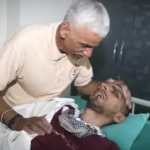
Rana’s tragic life began with his fall off of the fourth floor of his PG accommodation at Punjab University in 2013, resulting in severe brain damage, leaving him in a vegetative state, and with no functioning brain or ability to regain consciousness. He will continue to require mechanical assistance for the rest of his life, which has been over ten years so far, and has been living in a hospital bed with mechanical assistance for both breathing and feeding.
A Family’s Long Wait for Closure
With every passing year, so did the belief in a better future for him. After having been through years of extreme pain and no hope, his parents, who have stayed by his side throughout this time, have now gone to the courts to assist them (his parents) in obtaining dignity at death for their son after he had suffered all these years as a hideously deformed man. The current case presents numerous ethical and legal questions along with the renewed public debate about end-of-life issues and how to die with dignity in India.
A Landmark Court Decision
The Supreme Court of India’s recent ruling allows the application of passive euthanasia for people like Mr. Rana, who had been in a state of total disability for over 13 years with no expectation of recovery (and without medical help for their own failures). Following this ruling, the Supreme Court has recommended that the government develop a comprehensive legal framework for the future use of passive euthanasia as an option to facilitate “death with dignity”.
Although there is an ethical obligation on the part of the medical profession to try and preserve life using the latest modern forms of treatment, if there is clear evidence that a patient cannot be treated to the point of returning to a healthy state, then it is the responsibility of all those members of the medical profession to treat patients with dignity while assisting to end their lives.
A Carefully Managed Farewell
After the verdict was given, Rana was admitted to AIIMS Delhi on 14th March. A specialised team of doctors was there throughout the process.
Life support was withdrawn gradually under medical supervision, ensuring comfort and dignity at every stage until his peaceful death 11 days later.
In a final act of generosity, Rana’s family donated his organs/tissues, including 2 corneas and heart valves, providing others with hope during loss.
The Larger Legal Context
The history of passive euthanasia in India began with Aruna Shanbaug vs. Union Of India, when the Supreme Court permitted the removal of Aruna Shanbaug’s life support system under particular conditions. However, the Court did not allow for euthanasia for Aruna.
The case of Rana is an evolution. It will be the first time in India when euthanasia has been granted and executed to someone under the request of their immediate family and also with the permission of a judge.
A Death That Sparks Reflection
Harish Rana’s journey is both tragic and transformative. It reflects the emotional toll on families, the limits of medical science and the ethical dilemmas faced by society.
His case may shape future debates and policies around end-of-life care in India. For many, it also raises a difficult but necessary question. What does dignity mean when life itself is no longer within reach?
As the country reflects on this moment, Rana’s story stands as a reminder of compassion, resilience and the quiet strength of a family that waited 13 long years.
Also Read Two Indian LPG Tankers Cross Hormuz Safely, Set To Reach India Soon