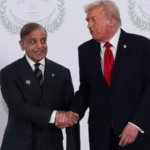
There is a subtle but important change in international diplomacy, and Pakistan is playing an important role as a back-channel negotiator between the United States and Iran, along with Turks and Egyptians. The emergence of Pakistan as a mediator between these two great powers, however, also highlights the current state of relations between India and its immediate neighbourhood.
In the context of the increased tensions that currently exist in the Middle East, analysts and policymakers alike have found the lack of India’s involvement in these efforts troubling.
A Setback to India’s Longstanding Approach
For decades, India has employed a policy to decrease Pakistan’s power on the international stage, and one of the main goals of this policy has been the diplomatic isolation of Islamabad.
But by helping enable dialogue between the U.S. and Iran, Pakistan seems to have ongoing strategic significance with its apparent ability to mediate a relationship between two countries.
This has led to doubts about the efficacy of India’s strategy toward Pakistan and whether or not India needs a new strategy towards Pakistan.
The Gap Between Visibility and Influence
Through prestigious engagements and high-level global summits, India’s prominent role as an emerging global power has been established through its global visibility. Indian leadership has consistently championed India’s growing stature as an emerging global power.
However, the public presence of diplomacy is not what defines diplomacy; rather, it relies on quiet negotiations and trusted contacts to effectively conduct diplomatic relations. The lack of India’s presence in important back-channel discussions suggests a disconnect between India’s visibility, operationally and diplomatically.
Countries that can engage in discreet negotiations with multiple parties are often better positioned to help resolve issues than those who cannot.
Balancing Relationships Has Become Harder
Historically speaking, India’s foreign policy has been centred around maintaining an independent foreign policy. As such, India has attempted to balance relations between competing powers, such as the US and Iran, to achieve this goal. However, due to changing global circumstances, it is now becoming more complicated for India to successfully execute this goal of balancing relations between the US and Iran. The implementation of US sanctions against Iran and the changing relationships between Iran and other countries have caused India to be cautious in how it interacts with Iran; therefore, while India’s caution to date may be understandable, it has likely diminished India’s ability to serve as a neutral third party mediating in the current conflict.
Pakistan’s Strategic Positioning
The geographical factors of where Pakistan is located in relation to Iran and the historical ties it has to the US help determine Pakistan’s role in diplomacy. By having access to both nations, Pakistan can serve as a connection point when there are no direct means of communication. While acting in this way will be short-lived, it lends credibility to Pakistan and improves its position as an influential member of the region.
At this time, Pakistan can use the opportunity to change how it is viewed and gain influence among other countries in the area with a more positive perception of itself.
The Rise of Flexible Coalitions
The presence of Turkey, Egypt and Pakistan indicates the rise of informal diplomatic forms of cooperation, based on practical considerations rather than traditional formal arrangements.
Coalitions of this type can be agile and operate with fewer restrictions than those of traditional formal alliances. They are often able to respond rapidly to situations and offer opportunities when larger powers are unable or unwilling to do so.
India’s exclusion from this informal coalition indicates a change in the regional dynamics of the area and may require closer examination.
What This Means for India
With a strong economy and significant strategic advantages, India is a global actor with an extensive track record within the world order. However, how much influence India has over international events is dependent upon more than just ability; it also depends on perception (of readiness to help), trust (of being a reliable partner), and capability (to mediate effectively). If major players perceive India to be too heavily aligned with one actor, its ability to mediate will be limited.
This situation is worth contemplating again; building connections across regions, maintaining diplomatic balance in relations, and utilising less formal avenues for engagement may help India return to a position of flexibility.
A Changing Diplomatic Landscape
The changing nature of diplomacy on an international scale is about influence rather than size or strength. Instead of being limited to size and power, diplomatic power comes from being able to adapt, having appropriate timing, and having the ability to connect and communicate across borders.
The emergence of Pakistan as a mediator between the United States and Iran is a prime example of this changing nature of international diplomacy. The challenge for India will be to respond to this evolution without sacrificing its long-term strategic objectives.
Ultimately, these types of situations do not set or alter a country’s path, but they do provide valuable insight into how important it is to be present, to have a presence, and to be prepared in an increasingly complicated world.
Also Read India-Pakistan Nuclear Risk Persists, Warns US Intelligence Report